
Gary Bloomer | SHAKING THE TREE #289

I have good news and bad news.
The good news is that if you act decisively and strategically over the next few years, you will position yourself to make the best out of AI technology by 2030.
The bad news is that the career map many of us followed just a few years ago is under threat.
Going to college, getting a qualification, and finding a job in a niche or specialist field such as law, philosophy, art history, or even English may no longer offer security and profitability.
I hope I’m wrong. But if I’m not, I think we should make a plan.
The career path we all bought into—the specialized degree, the entry-level role, climbing a single industry ladder—is transforming around us while we scratch our heads, wondering what’s happening.
Right now, advances in AI technology are driving the most profound set of challenges and opportunities in a generation for a highly specific kind of person: the strategic generalist.
Technology moves in waves
From the printing press to the age of the internet, we are facing one of the greatest shifts in human-centric design since the Renaissance and the Age of Enlightenment. From the late 1300s to early 1400s, five waves have occurred, none of which were flukes. Rather, they reveal an important pattern of human awakening.
While each wave shocked the system in the decade or so after its initial impact, each wave also gave us new tools and attitudes that fundamentally rewired what we believed was possible and what we could do, dramatically influencing how we think and behave.
The bridge to the sixth wave—the AI wave—comes from the transformed mindsets each previous wave created and each previous generation left behind.
Let’s identify the shift and connect the dots:
The First Wave. Movable type. The printing press did not just make knowledge portable. It broke the monopoly of the scribe and the institution. Movable type pushed the boundary of who could think and debate.
Behavior shifted from passive reception of dogma to personal interpretation and study. It planted the seed of the individual intellect.
Bridge to AI: AI represents the ultimate democratization of cognitive labor. Just as the printing press outsourced and scaled the act of copying, AI outsources and scales the act of reasoning, pattern recognition, and even creation. The first wave asked, “What if everyone could read?” The sixth asks, “What if everyone can analyze?”
The Second Wave. The Agricultural Revolution. This was not simply about growing and distributing cheaper vegetables; it severed our primal tether to the world of subsistence.
By mechanizing sustenance, the Agricultural Revolution freed time and thought for pursuits beyond mere survival. It pushed the boundary of what people could do with their days. As such, behavior shifted from communal, seasonal survival to specialization and trade.
Bridge to AI: AI mechanizes mental subsistence—the tedious, repetitive cognitive tasks that keep us pinned to our desks. AI promises to free human time and thought for higher-order pursuits: creativity, strategy, and the pursuit of meaning.
The second wave freed the body from the field; the sixth aims to free the mind from the spreadsheet.
The Third Wave. The Industrial Revolution. What the Agricultural Revolution did for farming, the introduction of the steam engine, railways, and industry did for commercial development.
The Industrial Revolution shrank the world conceptually, creating the first true networks of materials and people. It introduced the ethos of scale, efficiency, and system.
Human thinking shifted from local and artisanal to national, global, standardized, and logistical. We began thinking in terms of networks and throughput.
Bridge to AI: AI is the steam engine for information. Although it runs on data, not coal, its purpose is the same: to create immense, efficient, interconnected systems of intelligence. The third wave taught us to build physical networks; the sixth is about building cognitive ones.
The Fourth Wave. Electrification, communication, powered flight. This is the wave of instantaneity and amplified human agency.
The telegraph removed distance as an obstacle in communication; the internal combustion engine and the jet engine removed distance in mobility; the amplifier and the satellite gave a single voice national-level reach.
This wave pushed the boundary of human will: what we could command to happen, and how fast it took place. Behavior became more impatient, more global, more ambitious. We began to expect immediate connection and control.
Bridge to AI: AI is the culmination of instantaneity—a deceptively simple word for the single most important compression humanity has ever imposed on its own experience: the collapse of the delay between intention and effect, the removal of the gap between problem and solution.
Instantaneity amplifies human agency by autonomously executing our intent across digital and physical systems. The fourth wave gave us command over distance and force; the sixth gives us command over complexity.
The Fifth Wave. Personal computers, the internet, and digital democratization did more than speed up information. The fifth wave dissolved the gatekeepers of production and distribution. Anyone with a laptop or a cell phone can create, publish, connect, and compete in the global marketplace.
This wave pushed the boundary of who gets to participate by increasing access and decreasing barriers to entry, both in terms of technology access and affordability. The behavioral shift moved from being a consumer of culture and information to being a prosumer—a producer and consumer. Thinking became networked, collaborative, and remix-oriented.
Bridge to AI: AI is the final dissolution of the expertise gatekeeper.
You do not need to be a coder to build software, a painter to create compelling art, or a data scientist to run complex analysis. The fifth wave democratized the platform; the sixth wave democratizes the skill itself. It turns participation into co-creation with an intelligent agent.
So, how do they dovetail into the Sixth Wave—AI?
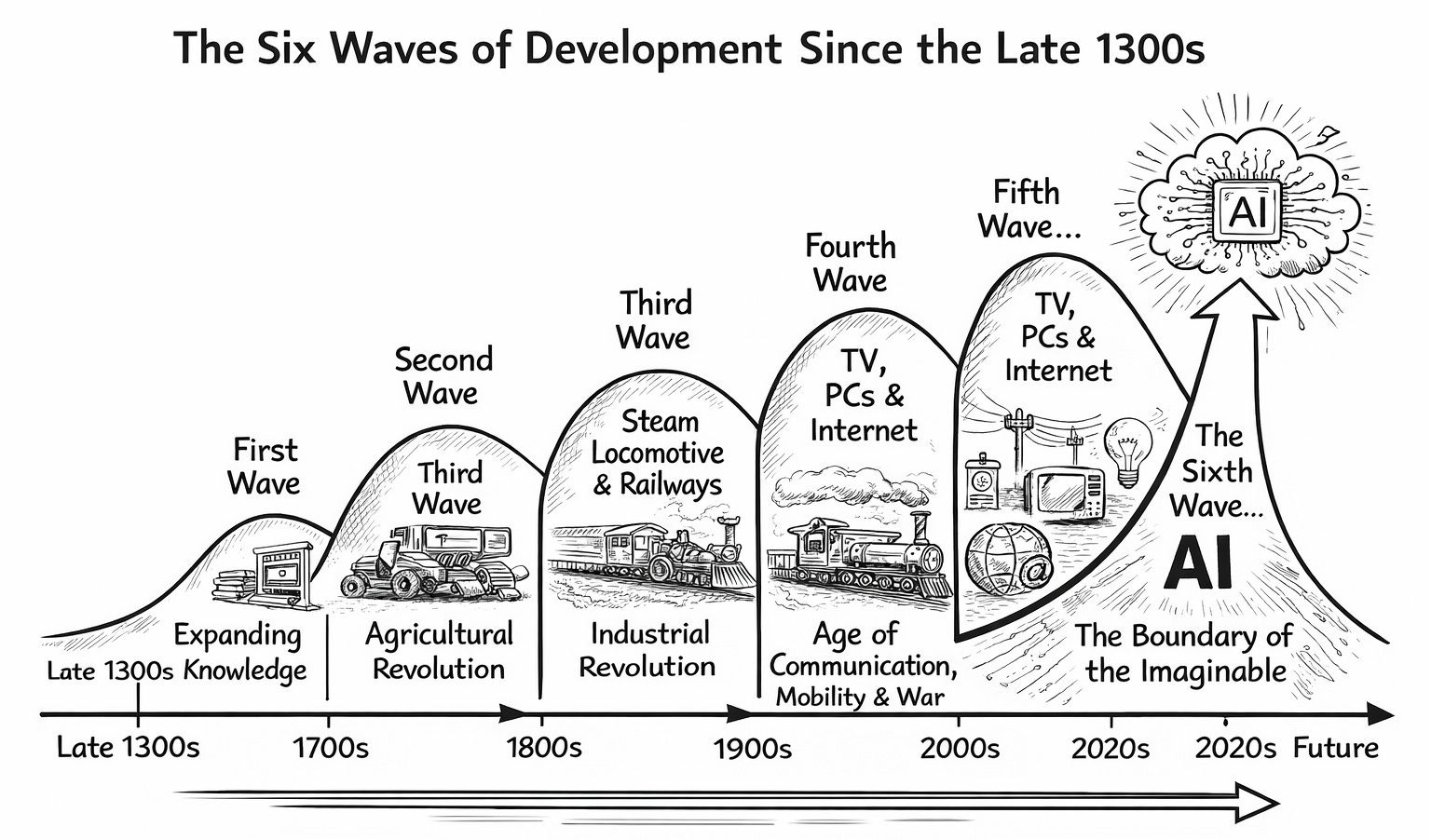
Each wave progressively outsourced a layer of human limitation: first manual copying (Wave 1), then physical labor (Wave 2), then logistical muscle (Wave 3), then the constraints of distance and time (Wave 4), and finally the barriers to access and production (Wave 5).
AI, then, is the wave that outsources cognitive limitation.
It is the convergent point. It requires the portable knowledge of the first wave, runs on the infrastructural and logistical thinking of the third, demands the instantaneity and systemic control of the fourth, and builds upon the democratized digital fabric of the fifth.
Most importantly, like the second wave, AI’s ultimate promise is liberation—this time, of human attention and intellect for the pursuits that make us uniquely human: curiosity, empathy, wisdom, and wonder.
The previous waves pushed the boundaries of the possible. AI pushes the boundary of the imaginable. AI does not just change what we do; it begins to change who we are in relation to our own creativity, our decisions, and our purpose.
That’s the shift.
We’re not just building tools anymore; we’re talking about building active collaborations.
If the Renaissance asked, “What does it mean to be human?” and the Age of Enlightenment asked, “How can we know?” the Sixth Wave asks: “What are we becoming, now that thinking is no longer ours alone?”
That’s the conversation we need to have. And that conversation needs to start now.
Since the beginning of the 20th century, the concept of employment value has rested on the idea of pursuing a deep, vertical area of professional expertise.
In fact, the world of education invested decades and hundreds of billions of dollars into building employment silos that worshipped specialization: teaching, engineering, architecture, banking, finance and the like.
However, AI is now commoditizing that depth and focus of attention at a staggering pace, which means certain sectors will likely shrink or disappear completely in time.
AI systems can now write code, analyze huge swathes of data at lightning speed, draft legal briefs, and generate creative concepts—maybe not perfectly, at least not yet, but in many cases at a competent enough junior-to-mid level to make senior managers nervous if they are paying attention. Sadly, many managers are NOT paying attention, and that could spell disaster.
On top of this, AI systems can perform tasks in a fraction of the time a qualified employee would take, and they can do all of this at near-zero marginal cost.
Think about this: three years ago—in 2023, as the pandemic was winding down—large language models (LLMs) could produce average, perhaps high-school level texts. Now, those same systems can write whole books in a matter of hours.
Again, the results still aren’t perfect, but with each new generation of software—which we see on a month-by-month basis—these systems become more capable and better able to perform a dizzying number of tasks.
While an AI system may not take your job away just yet, someone who can prompt, direct, and instruct AI systems will likely take your job in time.
This means that if you want to position yourself on the profitable side of the employment arc in terms of skillset, you must act within the next 18 to 36 months and begin honing your skillset now.
While the specialist will probably not become obsolete, the wave of AI has the potential to:
radically reengineer, retool, and redefine a specialist’s starting point,
change their role, and
impact their presence (and therefore their value and worth) in the job market.
The specialist of the future, therefore, is statistically likely to start beyond AI’s current baseline, someone comfortable using AI as a foundational tool instead of fearing it as a replacement.
This is where the generalist—the curious integrator, the willing synthesist, the cross-disciplinary translator, someone who can flex and change and act strategically—will move from the periphery of the job world into its epicenter. And as that happens, this person’s value will increase dramatically.
All of which means the critical window, the vital timeframe, is the next 2 to 4 years—from 2026 through the beginning of 2030. That is the time to build a strategic, focused, intentional, and unassailable personal and professional advantage.
Right now, the landscape to do this is wide open. If the world of technology is the Wild West, AI represents the wagon trains.
Here’s why, and here’s how:
The closing window of adaptation
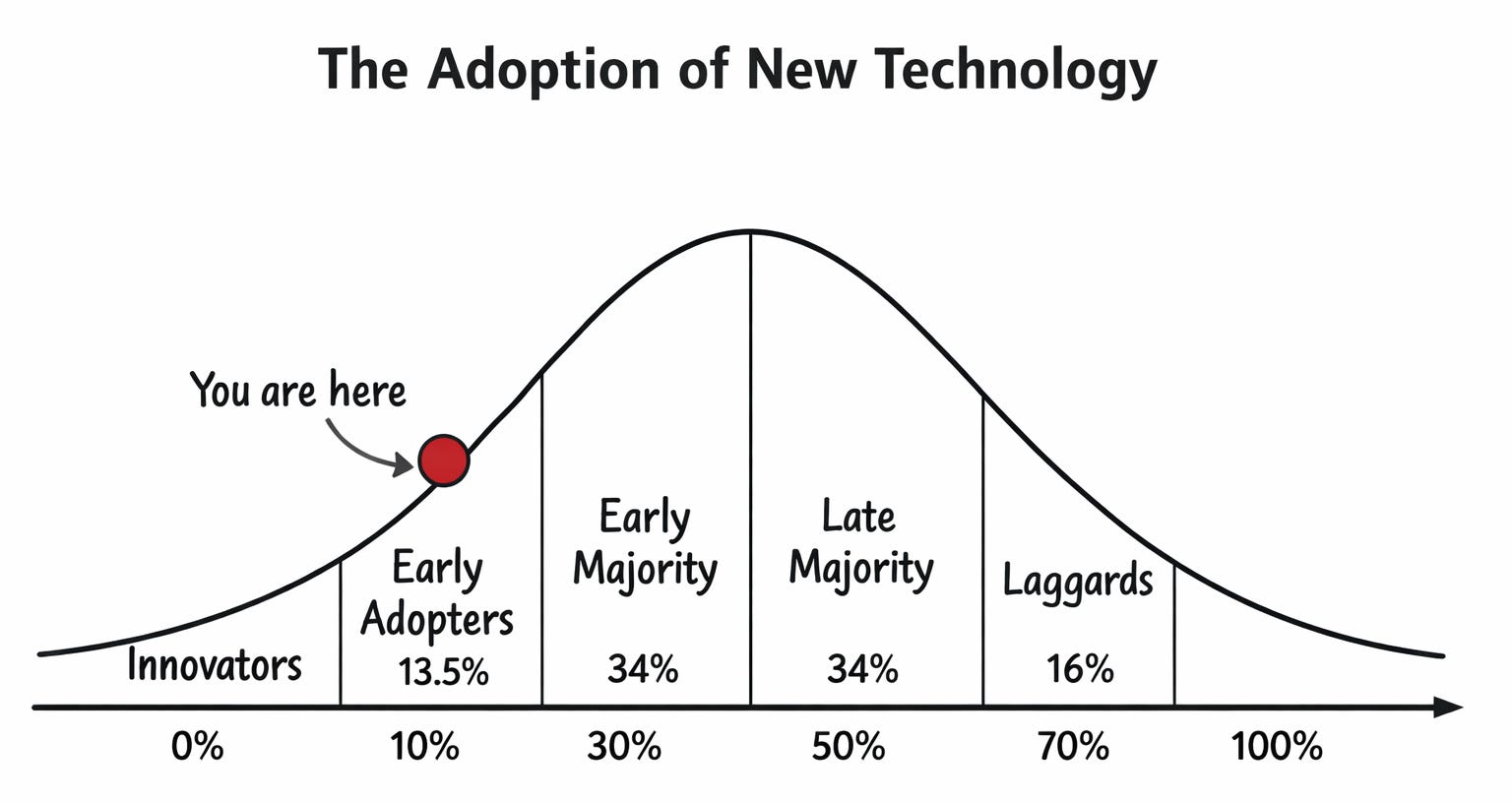
Right now we are on the steep part of the adoption curve, where AI proficiency still stands out as a skill because the technology is relatively new.
However, in 36 months, AI skills will likely become the assumed baseline, much like creating and sending an email or using a web browser’s search function were in the early 2000s.
This period is the last great asymmetry—the time when a moderate, consistent, personal investment in learning new skills will yield disproportionate personal and professional returns.
The tools are still raw enough and new enough that learning them requires curiosity and a desire to experiment rather than a PhD and forty years of work experience. But this won’t last. And while the barrier to entry is currently low, the barrier to relevance is rising fast.
The old model is a fading blueprint
The traditional “learn, then earn, then retire” model assumed a stable career landscape; it was a marathon on a paved track. With AI, however, we are heading into an era of permanent off-roading. The half-life of skills is shrinking.
The experience of a freshman student currently beginning a specialized degree may soon be a snapshot of a world that no longer exists by the time that student graduates.
I gave a presentation to a group of graphic design students back in 1993 in which I warned that by 1998, as many as 30% of graduates would be doing something other than the job they were training for. As of 2024, a report from the Strada Institute for the Future of Work and the Burning Glass Institute states, “More than half of recent four-year college graduates, 52%, are underemployed a year after they graduate. A decade after graduation, 45% of those same graduates still don’t hold a job that requires a four-year degree.”
Clinging to a single-field identity may soon become a career liability; your industry might undergo AI-optimization, merge, or become irrelevant faster than any promotion cycle.
Over the next few years, loyalty to a specialist role may become less valuable than agility and an ability to work across multiple platforms.
The new core curriculum: building your integration engine
So, if not deep specialization, then what? I believe the goal should not be to compete with AI in knowledge retrieval or task execution but instead to become its conductor, its strategist, and its editor. In short, you need to learn to direct AI powerfully.
Your personal curriculum for the next 36 months may better serve you by focusing on building three new meta-skills:
1. Fluency over expertise
This means developing the ability to converse with AI at a high level across multiple domains. You do not need to be a coder, but you must know how to architect and clearly direct a simple solution that prompts an AI platform to build, test, refine, and debug.
You do not need to be a graphic designer, but you must direct AI to iterate on visual concepts that serve a strategic goal. You do not need to be an expert. You simply need to know enough to get the job done well and to stand out from people who know less than you.
Your action: Pick three unrelated domains outside your current comfort zone (e.g., basic Python scripting, digital marketing storytelling, introductory UX principles). Use AI tutors (ChatGPT, Claude, etc.) to achieve functional literacy in each. Not mastery—literacy. You simply need to know enough.
2. Synthesis as a superpower
AI generates infinite raw material. The human value lies in creating connections, judgments, stories, and narratives.
The generalist excels at taking output from three different AI-aided domains—say, market data, a technical feasibility report, and a draft blog post—and weaving them into a coherent strategy, story, narrative, or product vision that no single-model prompt could ever produce.
Your action: Practice “connection sprints.” Take a complex article and use AI to simplify it, summarize it, debate it, and extrapolate its implications for an entirely different field. Train your brain to become the integrator.
3. Ethical and practical judgment
AI is a tool and a mirror—it reflects our data, our biases, our creativity, and our instructions.
It has no inherent wisdom, taste, or conscience.
The critical human role is to ask, “Should we do this?” “Is this output true and fair?” “Does this feel right for our brand, our customer, our humanity?” This is not a technical skill. It requires philosophical, ethical, and emotional intelligence.
Your action: Intentionally pressure-test AI outputs. Feed it controversial topics, complex ethical dilemmas, or creative briefs. Analyze where it fails, reveals bias, or offers a technically perfect but morally vacant solution. Hone your own judgment as the final, indispensable layer.
Your 36-month manifesto
The plan is simple, but it requires a shift in your thinking from passive career management to active capability building.
Year 1: The sandbox year. Dedicate one hour a day. Break things. Make AI write, code, analyze, and create for you in domains you know nothing about. The goal is fearless familiarity.
Year 2: The project year. Use your new fluency to initiate and complete a real-world project that requires cross-domain AI use. Launch a micro-business, automate a community report, build a tool for a non-profit. Create a portfolio piece that people cannot categorize neatly.
Year 3: The leverage year. Position yourself as the bridge. In your organization or network, become the person who connects the dots between the AI-aided work of specialists. Your title might not change, but your role will—you become the force multiplier.
The specialist designs and builds a better hammer, a more functional wrench, or a new screwdriver. Meanwhile, the generalist, armed with AI, sees the entire blueprint and the final structure in its landscaped setting.
The AI generalist understands the physics of the tools and the economics and aesthetics of the finished house. The AI generalist orchestrates the symphony of tools, furnishes the rooms, and turns the raw materials into a comfortable, familiar home.
The next 2 to 3 years are not about waiting for the future to happen. They are about actively constructing the only specialty likely to remain future-proof: the art of intelligent AI integration.
The world does not need more experts in what was. It needs savvy navigators for what’s next.
It is time to begin drawing your map of the future.
As always, thanks for reading.
—Gary
Feel free to follow me on Twitter and LinkedIn
P.S. If you found this useful, share it with another creator who needs an ego check (in a nice way). Want more unfiltered takes on content creation? Join my newsletter. No fluff, just the stuff that works.
Next time on Shaking the Tree: Why it’s time to stop glorifying the grind
ABOUT THE AUTHOR: Originally from the U.K., Gary Bloomer is a writer, branding advocate, marketing specialist, and an award-winning graphic designer.
His design work has been included in Creative Review (one of the UK’s largest design magazines). Since 2009, he has answered over 5,000 marketing and business questions in the Know-How Exchange of MarketingProfs.com, placing him among the top 3% of contributors. He lives in Wilmington, Delaware, USA.