
Gary Bloomer | SHAKING THE TREE # 332
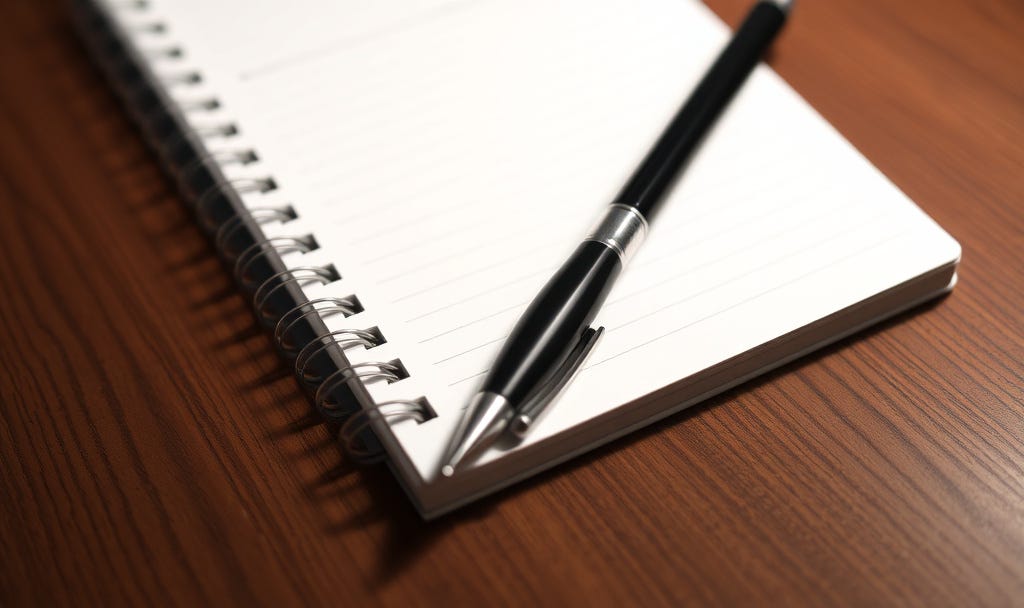
I’ve been sketching and making notes in notebooks for 40 years.
Most of those notes probably won’t ever see the light of day again. But every now and then, I jot down something that gets rolled into an article, or into a page layout, and when that happens, I get a little excited for the creative process.
Here’s what I’ve learned in the last six months about hand written notes and AI.
By taking a photograph of a page of notes and copying and pasting that photo into Google Gemini and telling the platform to transcribe the handwritten materials, that’s exactly what it does!
For me, figuring this out has reignited my interest in carrying a notebook.
It means I can make notes, have Gemini transcribe them, and then expert the text to a word processor, saving me the trouble of having to hand copy notes in real time.
This process takes a few seconds.
Gemini can read my handwriting (and it’s spookily accurate at doing so), which is a huge time saver.
Now, I know what many of my readers might be thinking: Gary, why not simply type your notes to begin with, from scratch?
Sure. Why not? There’s nothing wrong with this approach.
However, creativity isn’t simply about getting stuff down quickly, it’s also about letting ideas brew, much like making a decent cup of tea.
The problem with typing isn’t that it’s bad—it’s that it’s too easy.
When you sit in a meeting or a lecture and you’re typing away, or when you read a book with a laptop open, your fingers operate at the speed of dictation.
You stop being a student of human nature and you become a court reporter, someone capturing syntax verbatim without ever running the ideas through your own mental filters of hmmm, and oh, what about … and so on.
Your keystrokes bypass deep your processing ability in favor of rapid transcription.
Writing by hand forces you into a completely different transaction with your brain.
Because your hand cannot match the speed of spoken thought or rapid speech, you are immediately forced to slow down, to make connections, and to consider executive decisions.
Since you can’t write everything down, you’re forced to think, listen, synthesize, evaluate, and distill. You don’t just record the idea; you distill it down to its core geometry before, during, and after the nib of your pen touches paper.
That physical resistance—the literal friction of pen on paper—is where comprehension actually happens. And without comprehension, there can’t be any understanding.
So. Get yourself a notebook and something to write with. Find a comfortable spot somewhere, and let your mind wander. And see where your thoughts take you.
As always, thanks for reading.
—Gary
Feel free to follow me on Twitter and LinkedIn
P.S. If you found this useful, share it with another creator who needs an ego check (in a nice way). Want more unfiltered takes on content creation? Join my newsletter. No fluff, just the stuff that works.
Next time on Shaking the Tree: Inspiration is everywhere.
ABOUT THE AUTHOR: Originally from the U.K., Gary Bloomer is a writer, branding advocate, marketing specialist, and an award-winning graphic designer.
His design work has been included in Creative Review (one of the UK’s largest design magazines). Since 2009, he has answered over 5,000 marketing and business questions in the Know-How Exchange of MarketingProfs.com, placing him among the top 3% of contributors. He lives in Wilmington, Delaware, USA.