
Gary Bloomer | SHAKING THE TREE #288
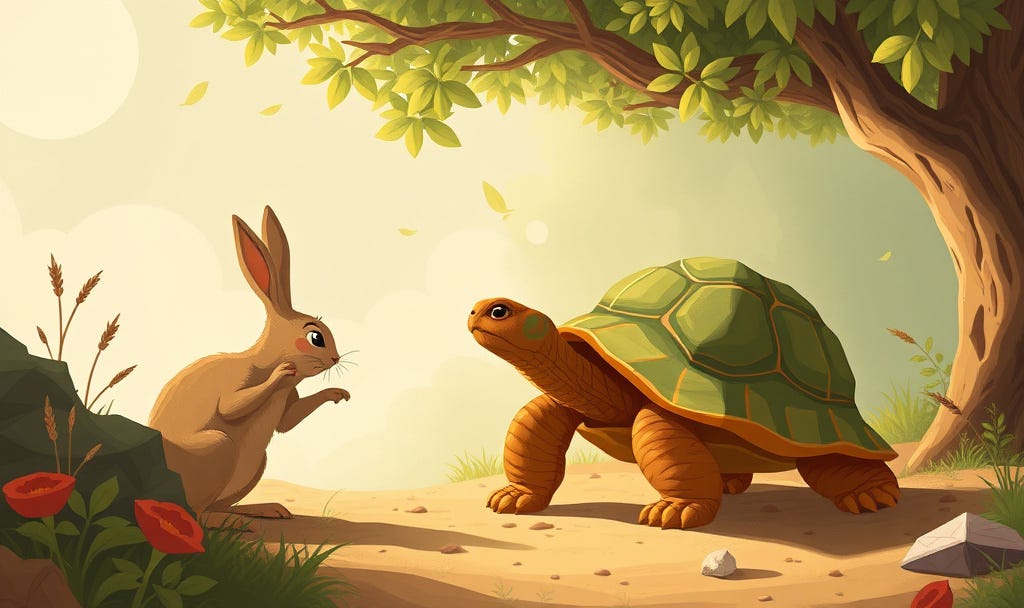
It’s story time!
Attributed to a storyteller believed to have lived in ancient Greece around the 6th century B.C., Aesop's Fables are a collection of short tales, often featuring animals, that conclude with a clear moral lesson.
Perhaps the most famous of them all is the story of The Tortoise and the Hare:
A boastful hare, confident in his speed, challenges a slow tortoise to a race. The hare dashes ahead and, certain of victory, stops to nap mid-race. The steady, plodding tortoise passes the sleeping hare and crosses the finish line first, proving that slow and consistent effort wins the day.
So, how does a tale from 2,600 years ago impact the sort of content you’re creating today? Like this:
Here’s something you won’t hear in the frantic scroll of your social media feed, or in the ping of yet another urgent notification, or even in the breathless pitch of another guru selling you the latest promise of hypergrowth in 30 days.
As the world screams “faster, more, now!” the single most radical, subversive, and potent act you can commit is to choose to move forward at your own pace.
The gurus might call it slow. Dull. Boring.
I call it strategic sovereignty.
More and more these days we’re living in the age of the digital hare, where hustle culture isn’t just a mentality, it’s ever increasing atmospheric pressure. It’s the expectation of instant replies, overnight success, rapid-fire content, and scale-at-all-costs.
The hare is flashy, hip, cool, and fueled by a relentless stream of adrenaline and external validation. Likes and shares and comments … oh, my!
The hare bursts from the starting line to the roar of the crowd. But as the old fable whispers—and it whispers because it has no need to shout—over time, the hare’s pace is less sustainable than you might imagine. The hare’s sprint, forgets that life is lived at excessive speed is a recipe for burnout; it sets us up to expect the best, which often leads to disappointment. And at the end of the spring there’s the haunting question once the noise fades: “What was I actually racing toward?”
These days, my superpower, one gained over a decade of false starts and wannabe go fast races—and one you can claim for yourself—is the deliberate pace.
The tortoise pace.
This isn’t about laziness. A deliberate pace is not a slow pace; it is a chosen pace. It is conscious, intentional, and untethered from the arbitrary pressures and clocks of others.
It’s the deep work that happens when you silence the notifications and delete the apps on your phone that are forever demanding your attention. The tortoise pace is the robust system you build brick by brick while others are slapping up flashy facades. It’s the relationship you nurture with your own peace of mind through consistent, undramatic presence. It’s the skill you master through simple, patient, unglamorous repetition long after the “natural talent” has burned out or quit.
The power of choosing your pace reveals itself in three profound ways:
1. Clarity over noise. When you stop frantically reacting to every trend, fad, and “emergency,” you gain the space to discern what you really want. You gain the ability to separate the signal from the noise (and Lordy, how much noise there is!). You get to figure out what’s truly important to you. You begin seeing what aligns most with your personal values and with your long-term vision. A hare is perpetually distracted by every other hare on the track. Meanwhile, the tortoise has its eyes on a horizon only it can see, its progress measured against its own pace and map.
2. Resilience over fragility. Systems built slowly have time to integrate, to stress-test, and to develop roots. They aren’t thin-skinned glass skyscrapers; they are tall, ancient oak trees. When the inevitable storm hits—a market shift, a personal crisis, a failure or some sort—the tortoise’s creation bends and creaks in the gale but what it doesn’t do is shatter because it’s stress tested. The hare’s house though, built in a day (and as good as it might look on the surface) is more prone to being blown away. Sustainable progress then is resilient progress.
3. Ownership over anxiety. The race you run on someone else’s stopwatch is a recipe for chronic anxiety, occasional panic, and an endless treadmill of pressure. You are forever behind, you’re never enough, you’re always chasing something. But when you slow down and when you set the rhythm, you own the experience. The pressure evaporates (because in truth, there was never any pressure). Suddenly, you discover a profound peace and a steady confidence, the sort of peace and confidence that come from knowing you are moving forward on purpose—at your own pace. Your energy then is yours to spend, not borrowed at interest from the bank of burnout.
The world’s obsession with “now” is an illusion. A shell game. And if you can’t tell what the product is, you are the product! The truly lasting things—mastery; trust; love; enduring art, and the success of deliberate, meaningful companies—are all crafted in the furnace of time. They cannot be rushed. Nor should they be.
So, I embrace the title. Call me a tortoise. I don’t care.
I’m moving at my own pace and with the weight of personal intention; as such, my pace is a declaration of steady independence.
I am building a life and a legacy, not just logging a sprint. I will arrive—not breathless and depleted, but steady, whole, and ready for what’s next.
The finish line belongs to those who endure. And endurance is a game of pace. So, what will you choose to be? The hare? Or the tortoise?
As always, thanks for reading.
—Gary
Feel free to follow me on Twitter and LinkedIn
P.S. If you found this useful, share it with another creator who needs an ego check (in a nice way). Want more unfiltered takes on content creation? Join my newsletter. No fluff, just the stuff that works.
Next time on Shaking the Tree: Reaching the point of "enough"
ABOUT THE AUTHOR: Originally from the U.K., Gary Bloomer is a writer, branding advocate, marketing specialist, and an award-winning graphic designer.
His design work has been included in Creative Review (one of the UK’s largest design magazines). Since 2009, he has answered over 5,000 marketing and business questions in the Know-How Exchange of MarketingProfs.com, placing him among the top 3% of contributors. He lives in Wilmington, Delaware, USA.