
Gary Bloomer | SHAKING THE TREE # 273
Much of the content we see online these days is boredom-killing decoration.
It’s flashy and catchy, it’s viral and vibrant. But what it lacks and what people crave most of all is connection and substance and intrigue.
You only get this things when you dig.
Dig? Yes, dig.
I used to work in museums and by far the most interesting people I worked with were the archaeologists. Why? Because they were uncovering the past and because they were filling in many of the missing pieces of the stories of people who are long dead.
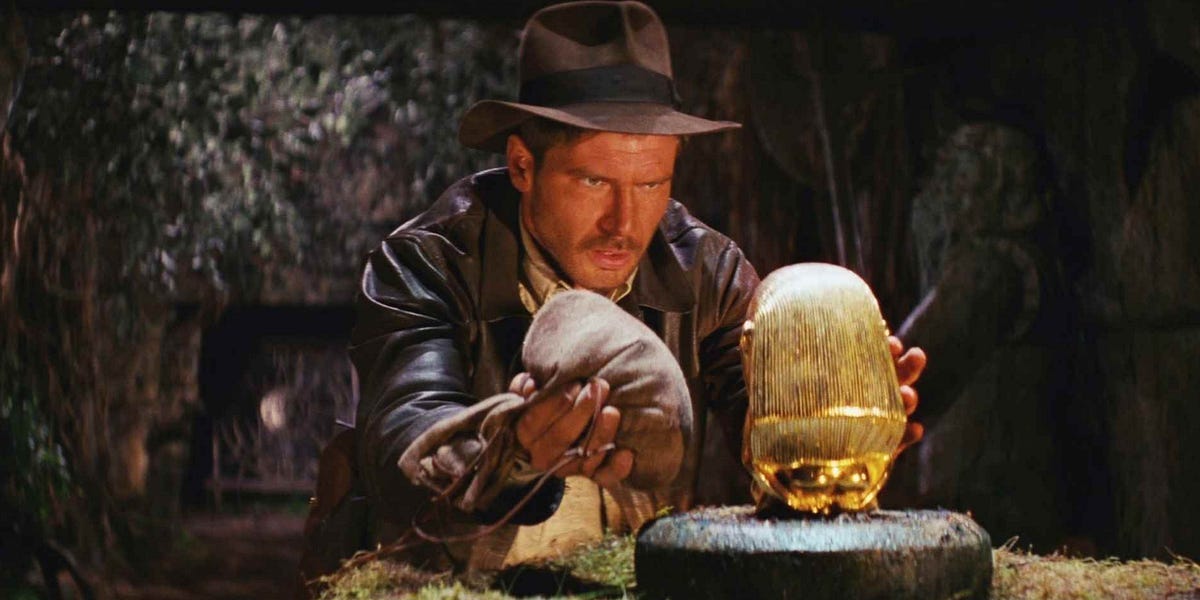
One of the reasons Indiana Jones has endured as a character and as a movie franchise is because every film tells a story: of love and romance, of excitement and adventure, of partnerships and friendships, and of mysteries and puzzles.
Indy was an archaeologist who worked in a museum.
When we dig we unearth truths and realizations. When we dig we pull away the roots and the debris and we reveal shining jewels and long hidden secrets.
I’m sure you’ve been told you need to tell stories. It sounds like another task on the list, just after find your niche and before optimize for SEO.
You think it means shaping your life into neat narrative arcs, finding the moral, crafting the climax.
You’re trying to build an everlasting fountain of youth, ornate, desirable, and impressive, when what you really need is a spade and a map on which X marks the spot.
Let me give you the fresh, unusual truth: A story isn’t something you tell. It’s something you uncover, something you reveal. It’s the hard, wet, worm-rich layer you find when you scrape away the manicured lawn of your niche and your content.
Stories are gritting and muddy. Stories are frayed at the edges and dog-eared on the corners. They might even bit a little bit torn at the folds and their seams might be sagging. But at every turn, these marks of life show the scrapes and scuffles that make them real and that therefore make the relatable.
While everyone else is busy adding glitz and decorating the surface—painting the fence, planting the showy annuals for quick colour—I urge you to dig beneath the surface because that’s where you’ll find the things that connect your narrative to real, lived experiences.
Recently, I watched an old interview with the actor Richard Burton who was answering questions about his friendship with fellow Welshman Dylan Thomas. Burton said the thing that set Thomas apart from other story tellers was his ability to go beneath the surface. Burton gave the example of commenting about the fact that Thomas had had a haircut. Burton recounted that “Yes”, said Thomas. “Let me tell you about the barber … .”
Here, many people would have told you about the haircut. But Thomas goes beyond this thinner layer of content because the truer story is about the barber … without whom there is no haircut. So in a sense, the real story—the one that roots people to you—is in the soil. Your job isn’t to invent, it’s to excavate.
Here’s the new, essential principle: People don’t follow a story. They follow the sounds of your digging.
When I post a photo of a potatoes pulled fresh from the ground, that’s just decoration. It’s pretty. It’s empty. But when I show you the forked, gnarled seed tubers I saved from last year’s crop—the ones that nearly rotted in the shed, and that I almost threw out—and when I tell you how the stubborn will of these gnarly, oddly shaped lumps to live mirrors my father’s character … that’s me digging.
That’s the story. It’s not about the crop; it’s about the latent life that would surely have been missed and dismissed. So, how do you pull this off?
Forget “What’s my story?”Ask instead:
What am I persistently turning over in my mind? (That’s your plot of land.)
What humble, “ugly” detail feels embarrassingly important to me? (That’s your first spade-strike.)
Where did I fail, hesitate, or get stuck today? (That’s the fertile layer.)
Your vulnerability isn’t in confessing sins or in admitting your shortcomings; it’s in showing the slow, gradual process of your unearthing.
The story is in slow unveiling of life, it’s in the resistance of the soil against the metal of the spade and in the clunk of the spade hitting a hidden rock—that’s a story.
Instead of idly tossing the rock aside; grab it, hold it up, rub the soil of it. Say, “Look what was in my way. It’s shaped like Ireland. I think I’ll build the path around it.”
If you’re a beginner creator and you’re afraid you have no stories I say: nonsense.
You are standing on them. You’re sitting right next to them. Your fingertips are touching them. You can smell them and feel them. They’re RIGHT THERE!
It’s simply that in order to look cool and refined and professional, you’ve either learned to or you’ve been taught to ignore them, to dismiss them as somehow being irrelevant to your goal of creating the perfect piece of content.
I’m urging you now to rip up the paving and to start digging in public.
Show people the draft you deleted, not just the final poem.
Show folks the tangled yarn, not just the finished sweater.
Show your audience the seedling crushed by the slug, and tell us why you felt a strange kinship with it.
This is the fresh truth: your authority doesn’t come from your expertise, but from your excavation.
People are starved for the smell of real earth.
They are drowning in polished surfaces.
Be the digger. Be the archaeologist.
Let your content be the hole, the pile of soil, the unexpected stone, the quiet triumph of a single exposed root, and the revelation of a hidden treasure.
The story isn’t the trophy. The story is the dirt under your finger nails and the smeared sweat on your brow. It’s the mud on your boots and the grass stains on your knees.
Now, go dig.
As always, thanks for reading.
—Gary
Feel free to follow me on Twitter and LinkedIn
P.S. If you found this useful, share it with another creator who needs an ego check (in a nice way). Want more unfiltered takes on content creation? Join my newsletter. No fluff, just the stuff that works.
Next time on Shaking the Tree: The rhythm of a good life
ABOUT THE AUTHOR: Originally from the U.K., Gary Bloomer is a writer, branding advocate, marketing specialist, and an award-winning graphic designer.
His design work has been included in Creative Review (one of the UK’s largest design magazines). Since 2009, he has answered over 5,000 marketing and business questions in the Know-How Exchange of MarketingProfs.com, placing him among the top 3% of contributors. He lives in Wilmington, Delaware, USA.