
Gary Bloomer | SHAKING THE TREE # 320
Spend any amount of time scrolling through any major social platform, reading modern corporate blogs, or skimming through the endless sea of newsletters, and you will quickly realize something alarming:
The internet has become a bland place.
Everything looks, tastes, sounds, and smells the same.
It’s the digital equivalent of eating plain, unsalted white rice for breakfast, lunch, and dinner.
It’s functional.
It fills a void.
But it is entirely, aggressively flavorless.
Many creators today are so terrified of offending a hidden algorithm or alienating a single potential follower that they serve their ideas completely raw, boiled, and unseasoned.
Either that or they are planning on thinking about considering the possibility of doing something: making a video; writing an article m, recording a podcast. But they never get around to it because, well, it’s easier to talk about it than to do it.
But to build anything worthwhile, whether it’s a brand, or a business, or a creative legacy that actually sticks to people’s ribs, you have to start treating your content like a master chef treats a signature dish.
You need to season the mixture as you’re cooking.
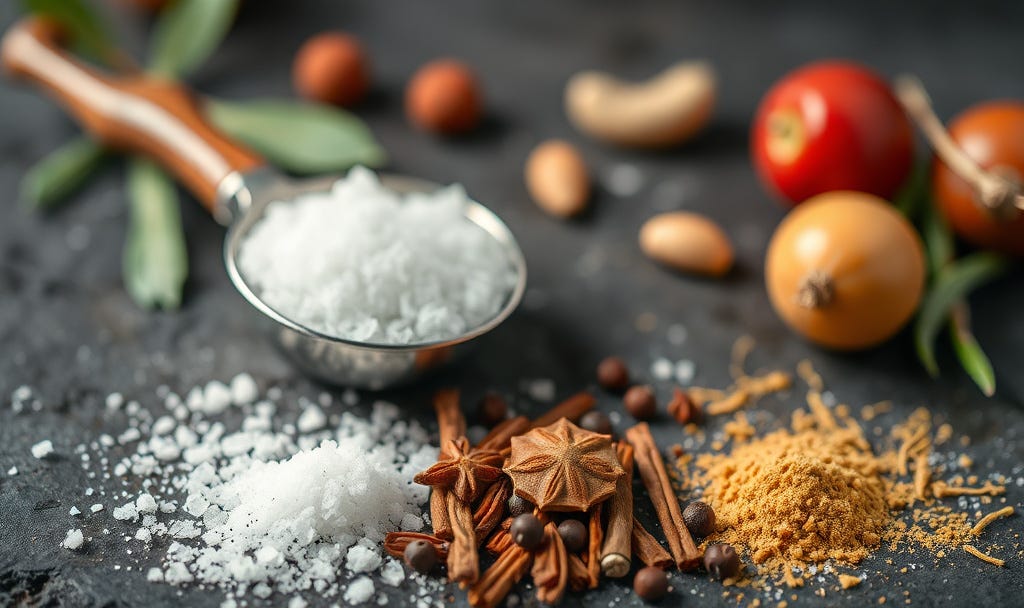
The base ingredient vs the spice rack
Information in whatever form is just the base ingredient for whatever you’re creating.
Fact sheets, “how-to” steps, and generic industry updates are just the raw potatoes.
Nobody goes to a five-star restaurant to eat a raw potato.
They go for what the chef does to those spuds.
Your unique perspective, your scars, your weird obsessions, and your hard-won philosophies—those things are your spice rack.
When you leave those things out, you’re not being careful or mindful, you’re being boring.
Let’s break down what the essential seasonings actually look like in practice:
1. The salt: raw life experience
Salt’s role isn’t to make food taste like salt; its job is to enhance the natural flavors that are already there.
In content, salt is your real-world mileage.
It’s the story of the business you crashed in your twenties, the grueling client interaction that taught you how to set boundaries, or the decade you spent mastering a craft.
I’ve been writing about this stuff now for three years on this website in its current incarnation and with each new article I write I like to think that a part of my experience comes through.
When you sprinkle genuine experience onto an instructional post, you instantly elevate it from theoretical textbook nonsense to authoritative, grounded truth.
2. The pepper: friction and contrast
A dish without a little bit of bite is a dish you forget. Pepper is your willingness to introduce elements of disagreement, shock, awe, and confession.
It’s your counter-intuitive opinion.
It’s taking a stand against the prevailing best practices of your industry and explaining exactly why you think they’re misleading garbage.
You don’t need to be completely outrageous or contrarian just for the sake of it, but there’s nothing wrong with introducing a little heat to surprise the palate because this kind of pepper forces the reader to pay attention.
3. The herbs: your personal philosophy
Herbs add brightness, aroma, and distinct identity to a dish.
Think of herbs as the underlying worldview, as the ethic ms and philosophies that guide your life.
Are you obsessed with craftsmanship and heritage design over cheap, disposable trends?
Let that bleed into your commentary.
Do you believe individual sovereignty is the ultimate human pursuit?
Let that framework shape how you analyze industry news.
Your philosophy gives your content a distinct aroma that people can recognize from a mile away.
4. The spice: the exotic and the unexpected
Spices are the unexpected pairings that make a dish unforgettable—like adding a dash of cinnamon in a savory chili. In your writing, spices are the lateral connections you make between completely unrelated worlds.
It’s using a lesson from 19th-century industrial history to explain modern SaaS marketing, or referencing a classic film to dissect a modern corporate scandal.
I’m a huge fan of this kind of connectivity because it helps people think about things in a different way.
When you add spices you demonstrate a breadth of mind. You show you don’t just consume the same digital slop as everyone else, you stand apart from it, which means you stand out.
Stop serving hospital food!
I spent multiple days in hospital in 2025 which time-wise was long enough to develop something of a loathing for instant scrambled eggs and instant mashed potato.
The fear with content creation of course, is that someone won’t like the flavor.
Some people can’t handle the heat.
Some people prefer things bland.
And that is exactly the point.
When you season your work aggressively with who you actually are, you will inevitably turn some people off.
Good.
Let them leave the table.
The goal of creating content isn’t to build a massive, lukewarm audience of people who mildy tolerate you.
The goal is to find the people who have been starving for exactly your kind of flavor.
Stop publishing hospital food.
Open up the spice cabinet, lean into your convictions, and cook something worth remembering.
As always, thanks for reading.
—Gary
Feel free to follow me on Twitter and LinkedIn
P.S. If you found this useful, share it with another creator who needs an ego check (in a nice way). Want more unfiltered takes on content creation? Join my newsletter. No fluff, just the stuff that works.
Next time on Shaking the Tree: Championing other people’s success
ABOUT THE AUTHOR: Originally from the U.K., Gary Bloomer is a writer, branding advocate, marketing specialist, and an award-winning graphic designer.
His design work has been included in Creative Review (one of the UK’s largest design magazines). Since 2009, he has answered over 5,000 marketing and business questions in the Know-How Exchange of MarketingProfs.com, placing him among the top 3% of contributors. He lives in Wilmington, Delaware, USA.